

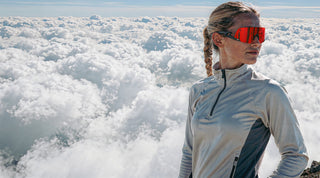
A high-altitude trail, a forest crossed at dawn, an exposed ridge in full sun for hours: when you go hiking, sunglasses are real technical gear, not just an accessory. They protect against UV rays, reduce glare and shield your eyes from wind, dust and small impacts along the way.
In this guide we look at how to choose the right sunglasses for hiking and why the Saetta and Fulmine models from Arena Eyewear are built to go with you on every trail.
In short
For hiking you need sunglasses with full UV protection, category 3 lenses for intense sun (category 4 only for high altitude and glaciers), a light and sturdy frame, and a stable fit. Saetta (24 g) and Fulmine (28 g) by Arena Eyewear combine a Rilsan® frame, polycarbonate lenses with 100% UV protection, an adjustable nose pad and 100% Italian manufacturing.

Why you need sunglasses for hiking
Quick answer
At altitude UV exposure increases because the atmosphere filters out less radiation, and it is amplified by reflective surfaces such as light-colored rock, water and snow. Good hiking sunglasses reduce eye strain, improve comfort and protect your eyesight during multi-hour outings.
The higher you climb, the more UV exposure increases, because the thinner atmosphere filters out less of it. On top of that there's light reflected off pale trails, rocks, bodies of water and especially snow, plus wind, dust and sudden shifts in brightness between forest and exposed ridges. Sunglasses designed for the outdoors tackle all of this at once, while staying stable on uneven ground.
How to choose hiking sunglasses: 6 criteria
1. UV protection
This is the minimum requirement. The lenses on Saetta and Fulmine are made of high-quality polycarbonate with 100% UV protection.
2. Lens category
The category indicates how much light the lens blocks. Category 3 suits the intense sun found on most trails and is used on all Saetta and Fulmine lenses. For extreme conditions, such as glaciers or very high altitude with persistent snow, category 4 lenses exist and are darker: always check the intended use before choosing.
3. Fixed, photochromic or polarized lenses
If your hike moves between sunny stretches and shaded areas (forest, gullies, mountainsides), photochromic 1–3 lenses adapt to the light. Polarized lenses, on the other hand, cut reflections off water and rock, but at high altitude they can make it harder to spot patches of ice on snow — worth weighing up based on the route.
4. Frame material
On the trail, a frame takes impacts, sweat, temperature swings and the weight of a backpack. Rilsan®, a high-performance nylon polymer, is light, flexible, has shape memory and resists impacts, scratches and extreme temperatures.
5. Fit and stability
Glasses that slip or bounce are annoying on uneven terrain. The adjustable nose pad on Saetta and Fulmine lets you fine-tune the fit, and the hydrophobic coating helps repel sweat.
6. Weight
After hours of walking, every gram counts: 24 g for Saetta and 28 g for Fulmine.
Saetta: lightweight and versatile for long walks
Saetta at a glance
- Weight: 24 g
- Lenses: category 3; photochromic 1–3 with a blue mirror finish
- Material: Rilsan®
- Colorways: 6
- Ideal for: hiking, multi-hour outings, trail running
Saetta is built for anyone covering miles of trails and mule tracks without even noticing they're wearing sunglasses. At just 24 g, it disappears on your face during the walk, and its wraparound design offers comfort and protection from dawn to dusk, whether you're in the forest or on an exposed ridge.

Fulmine: a wide field of view for mixed trails and faster pace
Fulmine at a glance
- Weight: 28 g
- Lenses: base 4/7, category 3; photochromic 1–3 with a fiery red mirror finish
- Material: Rilsan®
- Colorways: 6
- Ideal for: fast-paced hiking, mixed trails combined with biking or running, high altitude
Fulmine is the right choice if you hike at a faster pace, perhaps combining it with trail running or biking on the same route. The base 4/7 lenses provide a particularly wide field of view, while the wraparound design protects you from the wind on exposed ridges.

Which model for which type of trail
| Type of trail | Recommended model | Why |
|---|---|---|
| Multi-hour walks, low-to-medium altitude | Saetta | Just 24 g, disappears on your face during the hike |
| Mixed trails with biking or running | Fulmine | Base 4/7 lenses, wide field of view at higher speeds |
| Forest trails with variable light | Saetta or Fulmine photochromic | The lens automatically adapts to the switch between sun and shade |
| High mountains, glaciers, persistent snow | Category 4 lens (check availability) | Light reflected off snow is far more intense, needing a stronger filter |
Photochromic and polarized lenses: when it's worth choosing them
If your hike alternates between sun and shade (forest, gullies, climbs and descents, outings at dawn or dusk), photochromic lenses with a 1–3 filter save you from switching glasses mid-route. In the sun, Saetta takes on a blue tint, while Fulmine shifts to a fiery red one.
Polarized lenses, on the other hand, are very effective at cutting reflections off water, light-colored rock and snow, but on glaciers or snowfields they can make it harder to spot variations in the surface, such as patches of ice. For high mountains, the choice between photochromic and polarized therefore depends on the type of terrain you'll encounter along the way.
How to take care of your hiking sunglasses
- Rinse the lenses with water before cleaning them, so you don't drag dust and sand across the surface.
- Dry with a clean microfiber cloth, without rubbing while dry.
- Keep your glasses in a hard case while carrying them in your backpack.
- Avoid leaving them in the sun inside a car or tent: excessive heat can stress the frame and coatings.
Italian design, Made in Italy manufacturing
Saetta and Fulmine are designed by Frank Stephenson Design and made 100% in Italy at Lem Optical, a company based in Varese specializing in high-end eyewear. Find out more in our guides to fast sunglasses and why sports sunglasses are essential.
Frequently asked questions about hiking sunglasses
Which sunglasses should I choose for hiking?
Choose sunglasses with full UV protection, category 3 lenses for intense sun, a light and sturdy frame, and a stable fit. Saetta and Fulmine by Arena Eyewear meet these requirements, with a Rilsan® frame and adjustable nose pad.
What lens category do I need for hiking in the mountains?
For outings with intense sun, category 3 is suitable, and it's found on all Saetta and Fulmine lenses. For glaciers or very high altitude with persistent snow, category 4 lenses exist and are darker.
Saetta or Fulmine for hiking?
Saetta (24 g) is the lightest choice for long walks on trails and mule tracks. Fulmine (28 g, base 4/7 lenses) is preferable if the route is mixed with biking or running, or if you want a particularly wide field of view.
Are polarized lenses suitable for hiking in the high mountains?
They cut reflections off water and rock well, but on glaciers or snowfields they can make it harder to spot patches of ice on the snow. In those cases, a photochromic lens or a non-polarized category 4 lens may be preferable.
Are photochromic lenses good for hiking?
Yes, especially if the light changes often during the hike, for example between forest and exposed ridges. The photochromic versions of Saetta and Fulmine have a 1–3 filter and adapt to light conditions, with a blue mirror finish for Saetta and a fiery red one for Fulmine.
Conclusion
Whether you're planning a few hours on the trail or a multi-day hike at altitude, the right sunglasses make a real difference in comfort and safety. With Saetta and Fulmine by Arena Eyewear, you get lightness, UV protection and Italian design on every trail.