

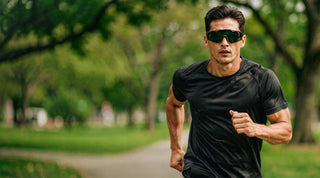
High-altitude trekking, bike rides, trail running at dawn or a day at the beach: when you spend time outdoors, sunglasses are genuine technical equipment, not just an accessory. They protect against UV rays, reduce glare and shield the eyes from wind, dust and minor impacts.
In this guide, we explain how to choose outdoor sunglasses and why Arena Eyewear's Fulmine and Saetta models are designed to accompany you on every adventure.
At a glance
For outdoor use, you need sunglasses with full UV protection, category 3 lenses for intense sunlight, a lightweight and durable frame, and a secure fit. Arena Eyewear's Fulmine (28 g) and Saetta (24 g) combine a Rilsan® frame, polycarbonate lenses with 100% UV protection, an adjustable nose pad, and 100% Italian production.

Why sunglasses are essential for outdoor activities
Quick answer
Outdoors, your eyes are exposed to UV rays, light reflected by water, rock and roads, as well as wind and dust. A good pair of sunglasses reduces eye strain, improves comfort and helps protect your vision over the long term.
The more time you spend outdoors, the greater your exposure to UV rays, which also increases with altitude and reflective surfaces such as water and roads. Glare, wind, dust and insects add to the challenge. Sports sunglasses address all these factors at once while remaining stable during movement.
How to choose outdoor sunglasses: 6 criteria
1. UV protection
It is the minimum requirement. The lenses of Fulmine and Saetta are made of high-quality polycarbonate with 100% UV protection.
2. Filter category
The category indicates how much light the lens blocks. Category 3 is suitable for intense sunlight and is used for all Fulmine and Saetta lenses. For extreme conditions, such as glaciers or very high altitudes, category 4 lenses are available, but they are not suitable for driving: always check the intended use.
3. Fixed or photochromic lenses
If during your outing you move from sunny stretches to shaded areas such as woods, tunnels or valleys, photochromic 1–3 lenses adapt to changing light. They are available on both models.
4. Frame material
In outdoor conditions, the frame is exposed to impacts, sweat and temperature changes. Rilsan®, a high-performance nylon polymer, is lightweight, flexible, has shape memory, and resists impacts, scratches and extreme temperatures.
5. Fit and stability
Sunglasses that slip or move around are impractical during activity. The adjustable nose pad on Fulmine and Saetta lets you customize the fit, while the hydrophobic treatment helps repel sweat.
6. Weight
After hours of walking or cycling, every gram matters: 28 g for Fulmine and 24 g for Saetta.
Fulmine: precision and field of vision for fast-paced outdoor activities
Fulmine quick facts
- Weight: 28 g
- Lenses: base 4/7, category 3; photochromic 1–3 with fiery red reflection
- Material: Rilsan®
- Colors: 6
- Ideal for: road cycling and MTB, triathlon, fast hiking
Fulmine is the choice for those seeking stability and control at high speeds. The base 4/7 lenses provide an optimal field of vision, while the wraparound design protects against the wind. At 28 g, with an adjustable nose pad, it stays comfortable all day.

Saetta: lightness and versatility for every day outdoors
Saetta quick facts
- Weight: 24 g
- Lenses: category 3; photochromic 1–3 with blue reflection
- Material: Rilsan®
- Colors: 6
- Ideal for: trekking, trail running, running, beach and leisure
Saetta is designed for those who go from trail to beach without changing sunglasses. At just 24 g, you barely notice it on your face, and the wraparound design provides comfort and protection from trail running to relaxing by the sea.

Which model for which outdoor activity?
| Activity | Recommended model | Why |
|---|---|---|
| Cycling and MTB | Fulmine | Base 4/7 lenses and stability at high speeds |
| Triathlon | Fulmine | Wide field of vision, secure fit |
| Trail running and running | Saetta | Only 24 g and a wraparound design |
| Trekking and hiking | Saetta (or Fulmine) | Lightweight for hours of walking; photochromic lenses if light conditions change |
| Beach and leisure | Saetta or Fulmine | Category 3 filter and Frank Stephenson Design styling |
Photochromic lenses: when they are worth choosing
If your outing alternates between sun and shade — wooded trails, climbs and descents, workouts at dawn or dusk — photochromic lenses with a 1–3 filter mean you do not need to switch sunglasses. On Fulmine they take on a fiery red tone in sunlight, while on Saetta they become blue. If your outings always take place in full sun, fixed category 3 lenses are the most straightforward choice.
How to care for your sunglasses
- Rinse the lenses with water before cleaning them, so you do not drag dust and sand across the surface.
- Dry with a clean microfiber cloth without rubbing the lenses while dry.
- Store the sunglasses in a hard case while traveling, including inside a backpack.
- Avoid leaving them in a car in the sun: excessive heat can stress the frame and lens treatments.
Italian design and Made in Italy production
Fulmine and Saetta are designed by Frank Stephenson Design and manufactured 100% in Italy by Lem Optical, a Varese-based company specializing in high-end eyewear. Find out more in our guide to speed sunglasses and why sports sunglasses are essential.
Frequently asked questions about outdoor sunglasses
Which sunglasses should you choose for outdoor activities?
Choose sunglasses with full UV protection, category 3 lenses for intense sunlight, a lightweight and durable frame, and a secure fit. Arena Eyewear's Fulmine and Saetta meet these requirements, with a Rilsan® frame and adjustable nose pad.
What lens category is needed for the mountains?
For hikes in intense sunlight, category 3 is recommended and is used on all Fulmine and Saetta lenses. For glaciers or very high altitudes, category 4 lenses are available, but they are not suitable for driving.
Fulmine or Saetta for trekking?
Saetta (24 g) is the lighter choice for long hikes and trail running. Fulmine (28 g, base 4/7 lenses) is preferable if you also cycle or want a particularly wide field of vision.
Are photochromic lenses suitable for outdoor activities?
Yes, especially if light conditions change frequently during your outing. The photochromic versions of Fulmine and Saetta have a 1–3 filter and adapt to changing light, with a fiery red reflection for Fulmine and blue for Saetta.
Are Arena Eyewear sunglasses also suitable for the beach?
Yes. With a category 3 filter, 100% UV protection and a wraparound design, Fulmine and Saetta also work well at the beach and for leisure.
Conclusion
Whether you love cycling, walking, running or simply spending time outdoors, the right sunglasses make a difference in comfort and safety. With Fulmine and Saetta by Arena Eyewear, you get lightness, UV protection and Italian design on every adventure.