

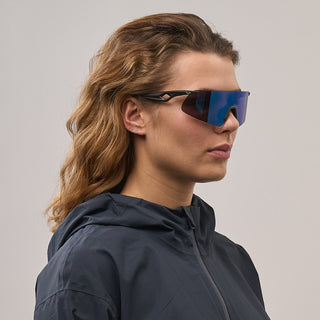
Running Sunglasses: How to Choose Lenses, Frame and UV Protection
When we talk about running gear, shoes, technical apparel and smartwatches come to mind first. Yet one equally important accessory is often underestimated: running sunglasses. They are not ordinary sunglasses but tools designed to deliver protection, comfort and stability, as also highlighted by My Personal Trainer.

Why do you need specific sunglasses for running?
Running sunglasses protect your eyes, improve vision and stay in place even with sweat and movement. Ordinary sunglasses, heavier and less snug, tend to slide and bounce with every stride.
Protection from the elements
Runners face varied and unpredictable environments. A good pair of running sunglasses protects against:
- UV rays: UV400 lenses block 100% of UV-A and UV-B rays, preventing long-term eye damage.
- Wind and dust: they reduce eye irritation in windy conditions or on dirt trails.
- Insects and debris: at high speed or on trails, a protective lens can make all the difference.
- Glare: polarized lenses reduce reflections from wet asphalt, shiny surfaces and snow.
Sharp vision and visual comfort
According to My Personal Trainer, clear vision is essential to stay focused while running. Quality sunglasses offer:
- better visual contrast, even in changing light;
- less eye fatigue, for longer sessions;
- optimal comfort thanks to lightweight, non-slip materials and an ergonomic design.
Which lens category do you need for running?
The category indicates how much visible light passes through the lens (VLT) and is defined by the EN ISO 12312-1 standard. The higher the number, the darker the lens.
| Category | Visible light transmission (VLT) | Suggested conditions | Suitable for driving |
|---|---|---|---|
| 0 | 80–100% | Very cloudy days, low light, wind and dust protection | Yes |
| 1 | 43–79% | Overcast sky, softer light | Yes |
| 2 | 18–42% | Medium light, cloudy but bright | Yes |
| 3 | 8–17% | Full sun, outdoor running in high brightness | Yes |
| 4 | 3–8% | Extreme brightness: high mountains, glaciers, snow | No |
UV400 protection and CE marking: what to check
A dark lens is not automatically a protective lens. UV400-certified lenses block 100% of UV-A and UV-B rays, meaning all wavelengths up to 400 nm. Always check that the glasses also carry the CE marking, which indicates compliance with European safety standards.
A dark lens without a proper UV filter can be even more harmful than no lens at all: the pupil dilates behind the dark glass and lets in more radiation.
Polarized or photochromic lenses for running: which is better?
Polarized lenses
They filter light reflected horizontally, for example from wet asphalt, shiny surfaces or water, reducing glare and increasing visual comfort, as My Personal Trainer explains. Be careful on routes with variable light or technical terrain: on trails, polarization can make it harder to read drops and obstacles.
Photochromic lenses
They adapt automatically to ambient brightness, with a gradual transition from light to dark. They are the best choice for runners who head out at dawn, at dusk or on routes mixing light and shade.
| Feature | Polarized | Photochromic |
|---|---|---|
| How it works | Filter that blocks horizontally reflected light | Darken or lighten depending on UV rays |
| Advantages | Less glare, more comfort on roads and shiny surfaces | One pair for different light conditions |
| Limits | Can make drops and obstacles harder to read on trails | The transition is not instant |
| Ideal use | Road running, sunny and reflective routes | Dawn, dusk, trails with variable light |
What should the frame of running sunglasses be like?
Beyond protection, comfort and stability matter. The ideal frame is:
- Light and wraparound, to stay firmly in place with every step;
- Breathable, to limit fogging during effort;
- Non-slip, with ergonomic nose pads and temples that grip even when you sweat.
A stable, lightweight pair helps keep facial muscles relaxed, supporting concentration and reducing fatigue, as Runlovers points out.
Materials: polycarbonate and TR90
Polycarbonate is preferable for lenses and TR90 for frames: lightweight, impact-resistant and durable materials that cope with rain, sweat and knocks without compromising vision. Among the most advanced lens materials are also Trivex and NXT, which combine lightness, impact resistance and high optical quality.
Arena Eyewear Saetta: Made in Italy running sunglasses

Arena Eyewear brings the experience of a leading design brand to sports eyewear, with a 100% Made in Italy collection. Among its flagship models is Arena Eyewear Saetta, designed for high-performance activities such as running and trail running.
The frame is made of Rilsan®, a high-performance nylon polymer that delivers lightness, flexibility, shape memory and resistance to impacts and weather. The soft, adjustable nose pad ensures grip and a customizable fit. The lenses are polycarbonate with high optical clarity, with hydrophobic and anti-reflective coatings.
| Feature | Detail |
|---|---|
| Frame | Rilsan®: light, flexible, with shape memory |
| Lenses | High-clarity polycarbonate |
| Coatings | Hydrophobic and anti-reflective |
| UV protection | 100% |
| Nose pad | Soft and adjustable |
| Design | Wraparound |
| Weight | 24 g |
| Photochromic version | Filter 1–3, available in Black Especial / Photochromic w/Blue Mirror |
Saetta colorways
- Saetta Black Especial / Photochromic w/Blue Mirror: the photochromic version, maximum versatility as it adapts to the light.
- Saetta Black Especial / Red Mirror: aggressive look and reduced glare thanks to the multilayer mirror coating.
- Saetta Opaline Teal / Green Mirror: unique style and sharp vision.
- Saetta Neon Orange / Silver Mirror: effective protection against intense light.
- Saetta Frozen Mint / Lavender Mirror: fresh, contemporary design.
- Saetta Frozen Silver Surfer / Gold Mirror: premium elegance and glare control.
How to run if you wear prescription glasses?
A vision problem does not mean giving up performance and comfort. There are solutions designed to combine vision correction and sport.
Clip-ins and optical inserts
- Optical clip-ins: prescription inserts that snap inside the sports frame. They are practical and adaptable, ideal for those who cannot tolerate contact lenses.
- Optical inserts (RX inserts): almost invisible, mounted behind the sun lens. Suitable for mild corrections and a discreet solution.
Dedicated prescription lenses
- Prescription sports glasses: fully prescription models made of performance materials such as TR90, with an ergonomic design.
- Optical adapters for sports eyewear: they keep the original filters of the sports glasses by adding only the prescription lenses, as offered by Ottica DMZ.
- Photochromic or polarized prescription lenses: they offer correction, visual comfort and impact resistance.
Solutions for presbyopia
- Flip-up corrective lens: mounts over the sun lens, useful for reading devices or maps.
- Glasses with a lower corrective section: let you check a GPS or watch without changing glasses.
Checklist: how to choose your ideal running sunglasses
| Criterion | What to check |
|---|---|
| Lens category | Category 3 for full sun; 1–2 for softer light |
| UV protection | UV400 certification and CE marking |
| Polarization | Useful on roads and shiny surfaces, less so on technical terrain |
| Photochromic | Great for changing light conditions |
| Frame | Light, ergonomic, ventilated, with a secure grip |
| Materials | Polycarbonate for lenses, TR90 or Rilsan® for the frame |
| Vision | Good contrast, lens color suited to the route |
| Design | Wraparound, protective yet functional |
| Price | In line with the technology and intended use |
How to take care of your running sunglasses
Good maintenance protects your eyes, keeps your vision clear and extends the life of your glasses.
Cleaning lenses and frame
- Initial rinse: wash the glasses with lukewarm water to remove dust and debris. Avoid hot water.
- Mild soap: apply a small amount of neutral liquid detergent and clean with circular movements.
- Careful drying: use a clean microfiber cloth and avoid abrasive materials.
Quick cleaning and anti-fog
On the move, a microfiber cloth and a lens spray are enough. To prevent fogging, use anti-fog sprays or wipes and choose a frame with good ventilation.
Case and storage
Always keep your glasses in a hard case to avoid scratches or breakage. Store them at room temperature and avoid very hot places such as a car dashboard.
Post-run maintenance
Regularly clean nose pads and temples to remove sweat and sebum, and check that screws and hinges are tight.
Frequently asked questions about running sunglasses
Which lens category do you need for running?
Category 3 (VLT 8–17%) is the best choice for running in full sun. For overcast days, categories 1 or 2 are enough. Category 4 is designed for high mountains and glaciers and is not suitable for driving.
Are polarized lenses good for running?
Yes on roads and reflective surfaces, because they reduce glare. On trails or in variable light they can make it harder to read drops and obstacles: in those cases a non-polarized or photochromic lens is better.
Are photochromic lenses suitable for running?
Yes, especially if the light changes during your run. They adapt automatically to brightness, with a gradual transition from light to dark.
What does UV400 mean?
UV400 means the lens blocks 100% of UV-A and UV-B rays, meaning all wavelengths up to 400 nm. Always check for the CE marking too.
How do you prevent sunglasses from fogging while running?
Choose a well-ventilated frame and use anti-fog sprays or wipes. After your run, clean the lenses with lukewarm water and a microfiber cloth.
Can you run with sunglasses if you wear prescription glasses?
Yes. The main solutions are optical clip-ins, prescription inserts behind the lens, optical adapters for sports eyewear and fully prescription sports glasses.
Why choose Arena Eyewear Saetta for running?
Saetta has a light, flexible Rilsan® frame (24 g), an adjustable nose pad for a secure grip, a wraparound design and polycarbonate lenses with hydrophobic and anti-reflective coatings. It is also available in a photochromic version.
Conclusion: three key points for choosing well
- Certain protection: UV400, CE marking and category 3 for full sun.
- The right lens for the route: polarized on roads, photochromic in variable light or on trails.
- Stable fit: a light, wraparound, non-slip frame with an adjustable nose pad.
With these three criteria, choosing running sunglasses becomes a technical decision, not just an aesthetic one. To find your pair, discover the Arena Eyewear collection.
Insight: when running eyewear sets the trend
Running sunglasses are no longer just technical tools: they are also a style trend, with futuristic shapes, mirrored lenses and colorful frames. Find out how the "fast glasses" (occhiali veloci) phenomenon went viral among athletes and creators: